Best FieldAssist Alternatives for Sales Force Automation

FieldAssist is a well-known sales force automation platform that helps FMCG companies manage field sales operations, distributor networks, retail execution, and sales performance. As a business grows, its needs can shift. A company running a small field team may eventually want deeper territory management, more flexible reporting, better distributor coordination, or stronger employee tracking.
That's when businesses start looking at FieldAssist alternatives. A good one does more than record sales orders or track attendance. It helps managers monitor daily field activity, improve beat coverage, verify retailer visits, coordinate with distributors, and keep accurate sales records without loading reps up with extra admin.
Plenty of platforms offer these capabilities, and they serve different needs. Some focus on FMCG distribution and retail execution. Others suit B2B sales teams, territory-based selling, and customer relationship management (CRM).
This blog compares 10 of the best FieldAssist alternatives for sales force automation, covering their key capabilities, the kinds of business each one suits, and what to weigh before you choose.
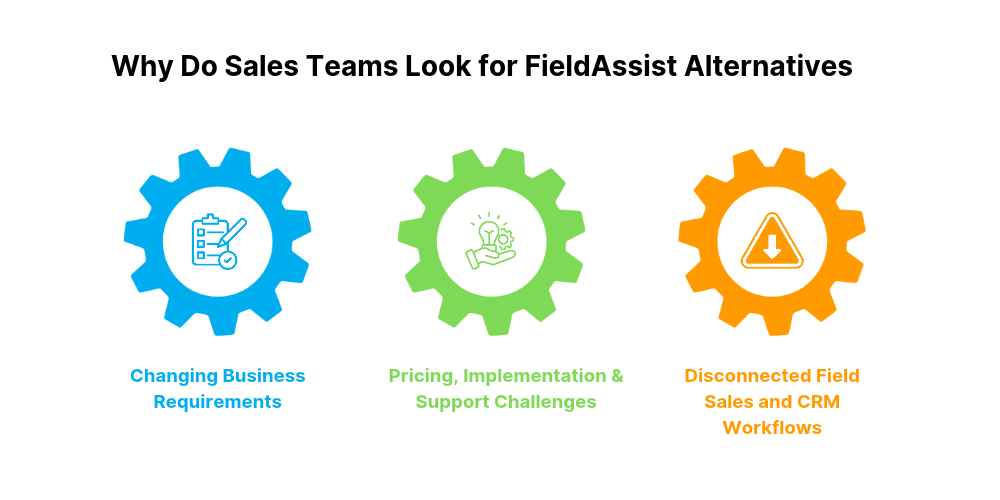
Why Do Sales Teams Look for FieldAssist Alternatives?
Replacing a sales force automation system isn't always about getting more features. The decision usually follows a change in team size, distribution setup, reporting needs, or the way managers supervise field reps. Here are some common reasons businesses look at alternatives to FieldAssist.
1. When the team outgrows a retail and FMCG-first workflow
FMCG companies live and die by outlet coverage, SKU availability, secondary sales, order booking, and distributor coordination. A specialized SFA platform can support all of that through structured beat plans, retailer visit tracking, and sales reporting. Businesses that span several industries often need something different.
A building materials distributor, for example, may need to track dealer visits, project enquiries, quotation follow-ups, and territory-wise order collection. An electrical goods manufacturer may care more about distributor performance, outstanding payments, and rep productivity. If the current workflow doesn't fit those needs, companies may look for a platform that can handle their sales processes without pushing every team into an FMCG-specific model.
2. When pricing, setup effort, or support stops matching the team size
Sales force automation software costs more than the subscription fee. Implementation, onboarding, training, integrations, customization, and ongoing support all add up. And a tool that suits 15 reps can get unwieldy once the company grows to 100 or more people across several territories.
Businesses tend to start comparing alternatives when:
-
The pricing is hard to justify as the team grows
-
Extra modules or customizations keep pushing the total up
-
Implementation drags on longer than planned
-
Reps struggle to adopt the mobile app
-
Support can't fix operational problems fast enough
3. When field execution and CRM needs have to sit in one tool
Managing a field sales team means more than logging customer visits. Managers also need to see what happens before, during, and after each one. A rep might visit a retailer, go over product availability, book an order, collect a payment, and set up the next visit. When those steps live in separate apps, it's hard for a manager to see the whole sales cycle.
Some businesses solve this with a platform that combines field force automation with customer management, order processing, payment collection, and performance reporting. Others do better with a dedicated CRM that has some field management features added on. The choice usually comes down to what matters more: running daily field execution well or managing customer relationships across the whole business.
10 Best FieldAssist Alternatives for Sales Force Automation
1. Delta Sales App
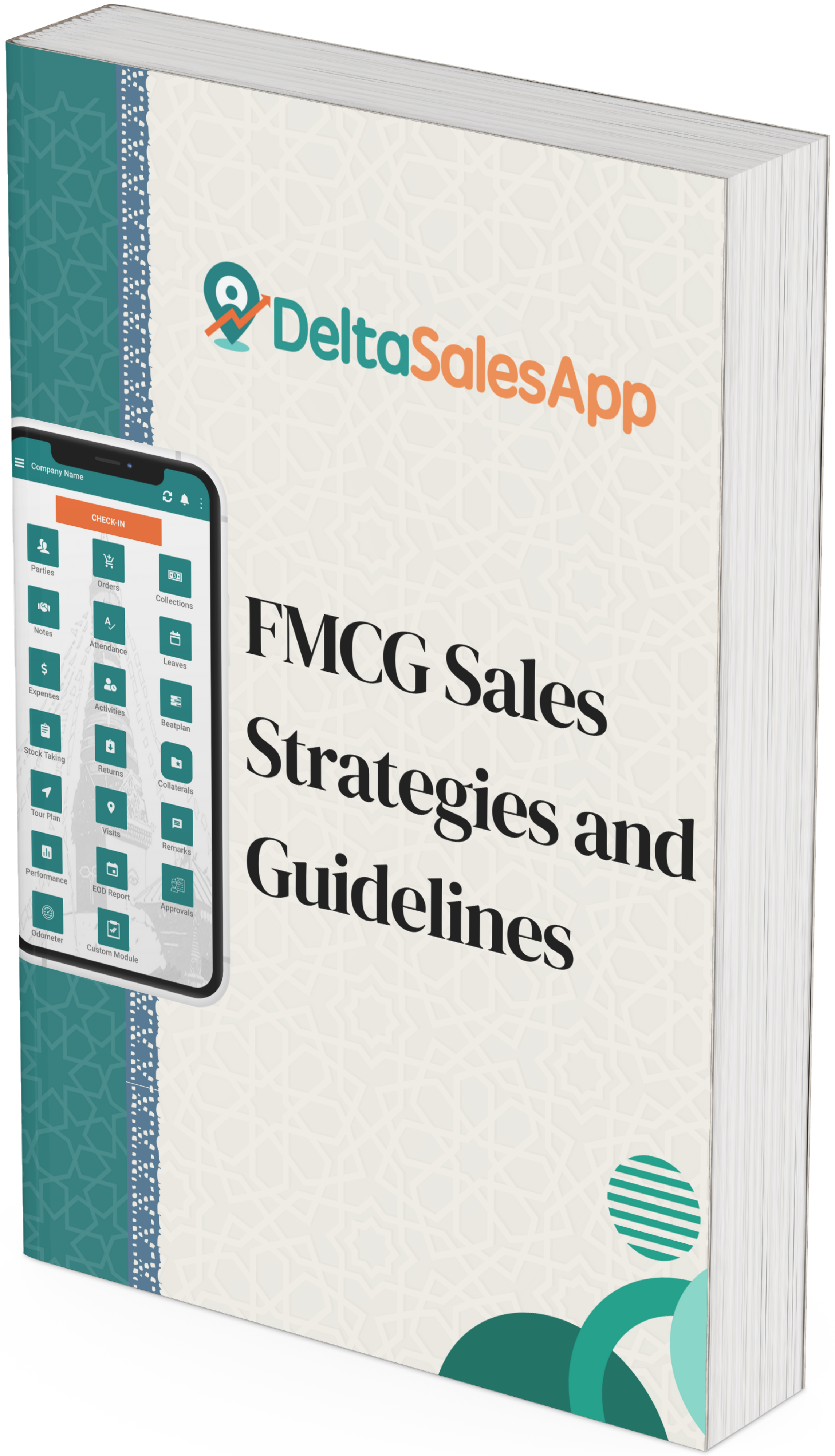
Delta Sales App is a field sales force automation and employee tracking platform for businesses that run outside sales reps, distributors, and retailer networks. It keeps order management, customer visits, attendance, and sales reporting connected, so companies can coordinate the field day without juggling tools.
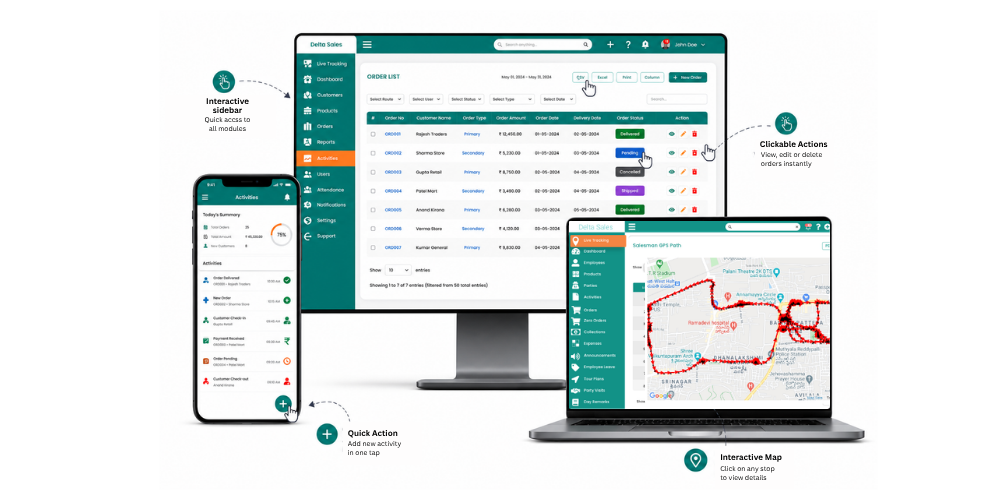
It also pairs field employee management with distribution workflows. Managers can watch rep activity and review the day's sales operations in one place, with no need for a separate app for each job.
Key features of Delta Sales App
-
GPS-based employee tracking: Monitor field representatives' locations, travel routes, and customer visits.
-
Beat planning and route management: Assign predefined customer routes and monitor whether representatives follow their planned schedules.
-
Order management: Allow representatives to book customer orders through the mobile application and maintain digital order records.
-
Payment collection: Record customer payments and monitor outstanding dues.
-
Attendance and leave management: Manage employee attendance, working hours, and leave applications.
-
Distributor and customer management: Maintain customer records, distributor information, and party locations.
-
Expense reporting: Allow field employees to submit expenses for managerial review.
-
Stock taking: Record retailer-level stock information to support better field-level decisions.
-
Automated reports and analytics: Review salesperson-wise, customer-wise, and monthly sales performance.
-
Offline functionality: Continue essential field activities without an active internet connection, with data synchronization when connectivity returns.
Delta Sales App is particularly relevant for businesses that need visibility into both employee activities and distribution operations. For example, a sales manager can review whether a representative completed the assigned beat, which included visiting the retailers, how many orders were booked, and what payments were collected. The platform also supports businesses beyond traditional FMCG operations, including paint, pharmaceutical, garment, lubricant, and other distribution-oriented industries.
Best for: Delta Sales App is suitable for FMCG companies, manufacturers, wholesalers, and distributors that need better visibility and control over their field sales operations. It helps businesses manage sales representatives, monitor retail visits, automate order booking, track payments, and improve distribution efficiency.
Business size: Suitable for small, medium, and large businesses, from growing distributors managing a small field team to established manufacturers and enterprises overseeing multiple sales representatives across different territories.
2. Bizom
Bizom is a retail intelligence and sales force automation platform that helps consumer goods businesses manage distribution and improve retail execution. It suits organizations that want visibility into distributor operations, outlet-level sales, and market performance.
Key features of Bizom
-
Sales force automation and field activity management.
-
Distributor management and sales visibility.
-
Retail execution and outlet-level monitoring.
-
Order management and sales reporting.
-
Sales performance analytics.
-
Market coverage and distribution tracking.
-
Retailer and channel management.
Bizom's strength is distribution intelligence. Managers can use sales and retail data to see how markets are performing, find distribution gaps, and keep an eye on execution across territories.
Best for: FMCG brands and large distribution networks.
Business size: Medium-sized and large enterprises.
Things to consider: Bizom is particularly focused on consumer goods and retail distribution. Businesses outside this operating model should evaluate how well its workflows accommodate their sales processes. They should also confirm implementation requirements, integrations, and pricing directly with the provider.
3. BeatRoute
BeatRoute is a sales force automation platform that helps businesses manage field sales execution, distribution activity, and customer interactions. It's built to improve how sales teams plan their work, carry out customer visits, and hit their targets.
Key features of BeatRoute
-
Field sales force automation.
-
Beat and journey planning.
-
Distributor and channel management.
-
Order and sales execution.
-
Retail execution and merchandising.
-
Customer and outlet management.
-
Sales performance monitoring.
-
Data-driven field sales insights.
Best for: FMCG and distribution businesses with complex field execution.
Business size: Medium-sized and large businesses.
Things to consider: Businesses should assess how the platform handles their specific distribution structure, reporting requirements, and mobile workflows. The level of configuration and implementation support should also be discussed before making a decision.
4. Botree SFA
Botree SFA is built to digitize field sales operations for consumer packaged goods (CPG) businesses. It covers sales execution, channel management, order processing, and retail-level revenue growth.
Key features of Botree SFA
-
Master data and channel management.
-
Outlet-level sales execution.
-
Order and return management.
-
Journey planning and route optimization.
-
Secondary sales management.
-
Van sales management.
-
Retail execution and merchandising.
-
AI-assisted selling and sales insights.
Best for: CPG companies and large-scale field sales operations.
Business size: Medium-sized and large enterprises.
Things to consider: Botree is primarily positioned around consumer goods and field sales operations. Companies should check the implementation scope, integration requirements, and suitability of their workflows for their particular distribution model.
5. Repsly
Repsly is a retail execution and field sales management platform that helps consumer brands coordinate in-store activity and monitor field performance. Its main focus is showing businesses what's happening at the point of sale. Managers don't have to lean on sales figures alone: they can also watch store-level execution, merchandising work, and how productive each field rep is.
Key features of Repsly
-
Field team scheduling and management.
-
Retail execution and merchandising.
-
In-store data collection.
-
Sales and activity reporting.
-
Mileage tracking.
-
Custom dashboards and analytics.
-
Ordering and product-related workflows.
-
Integrations with business systems.
Best for: CPG brands, merchandising teams, and retail execution.
Business size: Small, medium, and large businesses.
Things to consider: Repsly is more focused on retail execution than comprehensive distributor accounting or employee management. Businesses requiring extensive payment collection, distributor operations, or end-to-end order workflows should confirm whether additional integrations are needed.
6. SPOTIO
SPOTIO is an outside sales platform built for businesses whose representatives spend much of their working day visiting prospects and customers. Unlike platforms primarily designed around FMCG distribution, SPOTIO places considerable emphasis on territory management, lead management, route optimization, and sales pipeline visibility.
Key features of SPOTIO
-
Sales territory mapping and management.
-
Route planning and optimization.
-
Location-verified sales activity tracking.
-
Lead and prospect management.
-
Pipeline management.
-
Sales performance dashboards.
-
Mobile sales activity logging.
-
Sales automation and integrations.
Best for: B2B outside sales and territory-based teams.
Business size: Small and medium-sized businesses, including larger sales organizations.
Things to consider: SPOTIO is designed around outside sales and prospecting rather than FMCG-specific distributor management. Companies that depend on retailer-wise SKU orders, stock taking, and distributor payment collection should check whether their capabilities match those requirements.
7. Salesforce Sales Cloud
Salesforce Sales Cloud is a CRM platform designed to help businesses manage leads, customer relationships, opportunities, and sales pipelines. It is a different type of alternative to FieldAssist because its central focus is broader sales and customer relationship management rather than FMCG-specific field execution. Key features of Salesforce Sales Cloud
-
Lead and opportunity management.
-
Account and contact management.
-
Sales pipeline visibility.
-
Workflow automation.
-
Sales forecasting and reporting.
-
Customizable dashboards.
-
Mobile CRM access.
-
Integrations with other business applications.
Best for: Enterprise CRM and complex B2B sales operations.
Business size: Medium-sized and large enterprises.
Things to consider: Salesforce can require considerable configuration depending on the organization's requirements. Businesses seeking beat planning, retailer-level order booking, distributor management, and employee tracking may need additional solutions or integrations.
8. Zoho CRM
Zoho CRM is a customer relationship management platform that helps businesses organize customer information, manage leads, automate sales processes, and monitor pipeline performance. It can be a suitable alternative for businesses that want to strengthen customer management without necessarily adopting a specialized FMCG field sales platform. Key features of Zoho CRM
-
Lead and contact management.
-
Account and deal management.
-
Sales workflow automation.
-
Sales forecasting.
-
Custom reports and dashboards.
-
Territory management capabilities.
-
Mobile CRM access.
-
Integration with other Zoho applications.
Best for: Businesses needing CRM and sales automation.
Business size: Small, medium, and large businesses.
Things to consider: Zoho CRM is primarily a CRM platform. Businesses needing detailed daily beat execution, distributor stock management, retailer-wise order booking, and GPS-based employee monitoring should verify the availability of those workflows or consider additional applications.
9. HubSpot Sales Hub
HubSpot Sales Hub is a sales CRM and automation platform designed to help businesses manage leads, organize customer interactions, and improve sales follow-up processes. It is particularly relevant for organizations where sales representatives spend considerable time managing prospects, communicating with customers, and progressing opportunities through a sales pipeline. Key features of HubSpot Sales Hub
-
Contact and company management.
-
Deal and pipeline tracking.
-
Sales activity management.
-
Email tracking and sales engagement.
-
Meeting scheduling.
-
Sales automation.
-
Reporting and analytics.
-
Integration with HubSpot's broader CRM platform.
Best for: B2B sales teams focused on lead management and customer relationships.
Business size: Small, medium, and large businesses.
Things to consider: HubSpot Sales Hub is not primarily designed for FMCG distribution management. Organizations requiring GPS-based field attendance, distributor-wise sales, beat adherence, or retailer-level stock taking may need additional tools.
10. Pipedrive
Pipedrive is a sales CRM platform focused on helping businesses organize deals, manage customer interactions, and track opportunities through different sales stages. Its pipeline-based approach makes it useful for teams that need a clear overview of ongoing sales activities without managing a highly complex enterprise CRM environment. Key features of Pipedrive
-
Visual sales pipeline management.
-
Lead and contact management.
-
Deal tracking and forecasting.
-
Sales activity scheduling.
-
Workflow automation.
-
Custom reports and dashboards.
-
Mobile application.
-
Third-party integrations.
Best for: B2B sales teams focused on pipeline management.
Business size: Small and medium-sized businesses.
Things to consider: Pipedrive is primarily focused on sales pipeline management. It does not replace specialized field force automation requirements such as beat planning, GPS attendance verification, distributor management, or retailer-level order processing without additional solutions.
How to Choose the Right FieldAssist Alternative
Comparing software based only on its feature list can lead to the wrong decision. Two platforms may offer GPS tracking, order management, and sales reporting, but the way they support daily operations can be very different. Before selecting an alternative, identify the activities your sales team performs regularly and the problems managers want to solve. The following considerations can help narrow down your options.
For FMCG and distributor-led field teams
FMCG businesses need software that connects field sales execution with distributor and retailer operations. A platform that only tracks employee locations or records customer interactions may not provide enough operational visibility.
If your business manages primary and secondary sales, evaluate whether the software supports the following:
-
Beat planning: Can managers assign daily routes and monitor planned versus actual outlet visits?
-
Order management: Can representatives book retailer orders directly through the mobile application?
-
Distributor coordination: Does the platform provide visibility into distributor orders, stock, and sales activities?
-
Payment collection: Can representatives record payments and managers monitor outstanding dues?
-
SKU-level reporting: Can managers review product-wise sales and identify slow-moving or frequently ordered products?
-
Retail execution: Does the system support stock taking, outlet audits, and retail-level activity monitoring?
-
Offline access: Can representatives continue working in areas with weak or unavailable internet connectivity?
Consider a distributor managing 40 sales representatives across several territories. The sales manager needs to know whether representatives have covered their assigned outlets, whether orders have been booked, and whether collections have been recorded. A suitable SFA platform should bring these activities together rather than requiring managers to collect information from multiple sources.

For B2B teams that sell on territory and visits
Not every field sales team follows the FMCG distribution model. A building materials manufacturer, industrial equipment supplier, or electrical goods distributor may have representatives who spend their days visiting dealers, contractors, architects, project sites, and institutional buyers.
Their sales process may involve:
-
Identifying potential customers within an assigned territory.
-
Scheduling customer visits and meetings.
-
Recording discussions and product requirements.
-
Preparing quotations and tracking negotiations.
-
Following up on outstanding opportunities.
-
Recording orders and monitoring sales performance.
For these businesses, territory management and customer activity tracking may be more important than retailer-level merchandising.
Evaluate whether the software offers:
-
Territory-wise customer allocation.
-
GPS-based visit verification.
-
Customer and prospect management.
-
Visit scheduling and follow-up reminders.
-
Sales activity reporting.
-
Opportunity and quotation tracking.
-
Mobile access to customer information.
Questions to ask before you shortlist or book a demo
A product demonstration is an opportunity to understand how software performs in real operating conditions. Instead of focusing only on the dashboard or feature presentation, ask the provider to demonstrate workflows that reflect your team's daily activities.
Here are some important questions to include in your evaluation.
1. Can the software support our existing sales process?
Ask whether you can configure your beat plans, customer categories, order workflows, approval processes, and reporting structure according to your business requirements.
2. How does the mobile application perform without internet connectivity?
If representatives work in remote territories, offline access is important. Ask which activities can be completed offline and how the system handles automatic synchronisation.
3. How accurately can we verify field visits?
Check how GPS tracking, geo-tagged attendance, customer check-ins, and visit timestamps work. Understand what information managers can access through the dashboard.
4. Can we track primary and secondary sales separately?
For distributor-led businesses, reporting should distinguish between company-to-distributor sales and distributor-to-retailer movement wherever the platform supports those workflows.
5. What reporting and customization options are available?
Ask whether managers can generate salesperson-wise, territory-wise, customer-wise, product-wise, and monthly sales reports.
6. Does the platform integrate with our existing systems?
Check compatibility with your ERP, accounting software, inventory system, and other business applications. Confirm whether integrations are standard or require additional development.
7. What does implementation involve?
Understand the onboarding timeline, employee training, data migration, configuration requirements, and support available after deployment.
8. How does pricing change as the team grows?
Ask for a breakdown of user charges, modules, implementation fees, integrations, and additional services. Request an estimate based on your expected team size rather than the current number of users alone.
A useful evaluation method is to shortlist two or three platforms and ask each provider to demonstrate the same sales workflow. This makes it easier to compare usability, reporting quality, and operational suitability.
Final Thoughts
Choosing the right FieldAssist alternative depends on how well the software supports your sales operations, distribution network, and long-term business goals. While some platforms focus primarily on CRM, others specialize in field sales tracking, retail execution, or distributor management. However, businesses that manage both distribution and field sales need a solution that connects these activities rather than handling them separately.
Delta Sales App brings together the key capabilities of Distributor Management Software (DMS), Sales Force Automation (SFA), field sales management, and CRM in one integrated platform. It helps businesses manage distributor and retailer relationships and monitor sales representatives through GPS-based tracking and visit verification, plan sales routes and beats, automate order booking and payment collection, and track sales performance through real-time reports and analytics. Its offline functionality also allows field teams to continue working when internet connectivity is unavailable.
Whether you operate an FMCG company, manufacturing business, wholesale operation, or distribution network, Delta Sales App provides the tools to manage field activities and distribution workflows in a more connected way. Instead of relying on separate systems for different sales functions, businesses can bring essential operations together on one platform.
If you are evaluating FieldAssist alternatives, explore how Delta Sales App can support your sales and distribution requirements. Get a personalized product demo to see how its features fit your business workflows.