Best Outfield Alternatives for Field Sales and Order Capture in 2026

Outfield is a field sales CRM that helps outside sales teams manage customer accounts, track visits, plan routes, capture orders, and monitor sales performance. Its mobile-first design suits businesses whose reps spend most of the day visiting customers.
Field sales needs differ by industry, though. A consumer brand managing retail accounts has different operational needs from an FMCG distributor handling repeat retailer orders, payment collections, and secondary sales.
As a business grows, it may need more specialized capabilities: distributor management, SKU-level order booking, beat planning, attendance tracking, stock taking and detailed sales reporting. A platform that's good at managing customer relationships won't necessarily cover everything a distribution-led sales operation needs. That's why businesses look at Outfield alternatives. They want software that fits their sales process, supports their reps, and gives managers a better view of daily operations.
This blog compares eight Outfield alternatives for 2026, covering their key capabilities, strengths, and how well each suits different field sales requirements.
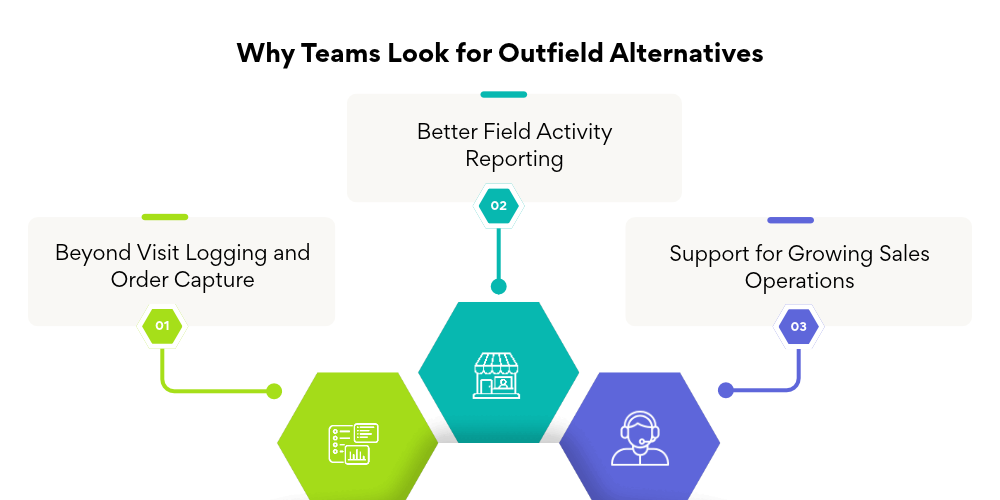
Why Do Teams Look for Outfield Alternatives?
Outfield combines field sales CRM, territory management, route planning, order management, and performance tracking. However, businesses may look for alternatives when their operational requirements become more specific.
-
When Order Capture Needs to Go Beyond Visit Logging
For businesses, a customer visit should do more than just record an interaction. Representatives may need to check orders, review product catalogues, apply pricing or schemes, book quantities, and record payment collections. Distribution‑led businesses managing distributors and retail outlets may also require stock visibility, secondary sales reporting, and order reconciliation. Distribution‑led businesses may therefore look for software that connects customer visits with the sales and distribution workflow.
-
When Managers Need Clearer Reporting on Field Activity
Managers need to understand whether representatives are following their beat plans, covering assigned outlets, generating orders, and achieving sales targets. Basic visit records may not provide enough information to evaluate field productivity. Businesses may need planned-versus-actual visits, productive call reports, territory-wise sales, payment collections, attendance records, and representative-wise performance dashboards.
-
When the Team Outgrows Its Current Setup
A field sales process that works for a small team can become difficult to manage as the business expands across territories and distribution networks. More representatives, customers, SKUs, and distributors create additional reporting and coordination requirements. Companies may need centralized customer management, role-based access, offline order booking, ERP integration, and more structured territory planning. An alternative should support these requirements without making everyday field activities unnecessarily complicated.
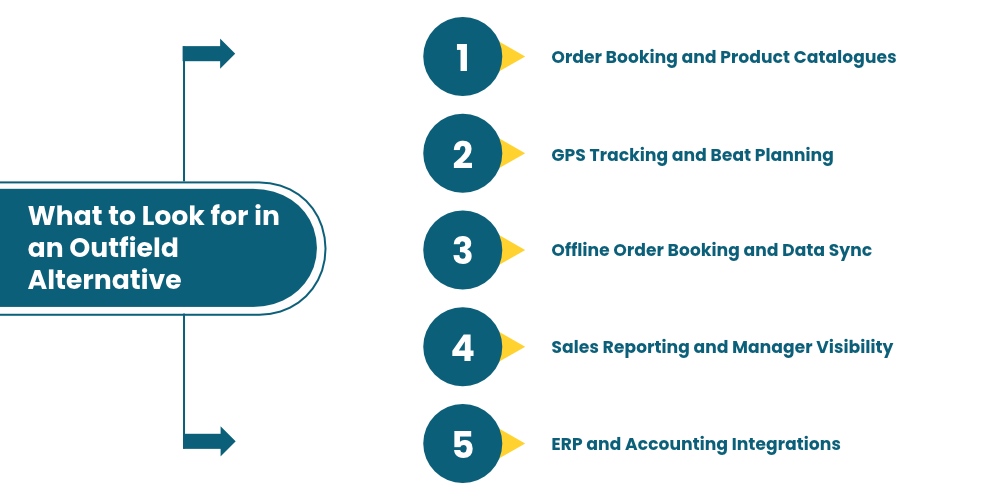
What Should an Outfield Alternative Offer?
The right platform should match the activities representatives perform during customer visits, and the information managers need to monitor sales operations.
-
Order Booking With Product Catalogues and Pricing
Look for mobile order booking with product catalogues, SKU details, customer-specific pricing, and promotional schemes. Representatives should be able to review previous orders, select products, enter quantities, and submit orders directly from the field. For distributors, stock visibility, returns, and payment collection can also be important.
-
Visit Tracking, Check-Ins, and Route Planning
GPS-based tracking, customer check-ins, visit verification, and route planning help managers monitor field activities. Beat planning is particularly useful for FMCG businesses that follow recurring outlet visits and need representatives to cover assigned territories systematically.
-
Offline Use for Patchy Network Areas
Reps should be able to finish the essentials when there's no internet, like pulling up customer information and booking orders. Check that records get stored on the device and sync on their own when it reconnects.
-
Reporting and Manager Visibility
Check if the platform offers DSRs, representative‑wise sales, outlet coverage, attendance, order summaries, and collection reports. If you run a distribution network, you might also want to look at sales and distributor-level reporting for your distribution network.
-
Integration With ERP and Accounting Tools
ERP and accounting integrations help connect field orders with inventory, customer records, pricing, invoicing, and payment processes. Check supported integrations, API availability, synchronization requirements, and implementation costs before choosing a platform.
Top Outfield Alternatives Compared
The following platforms offer different approaches to field sales management, order capture, and customer relationship management. Some are designed specifically for distribution-led businesses, while others focus on outside sales CRM or retail execution.
1. Delta Sales App
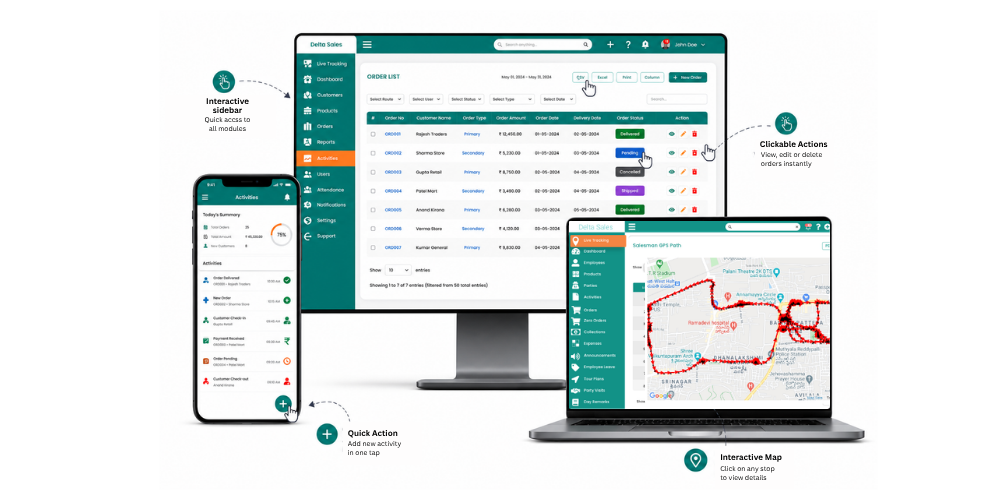
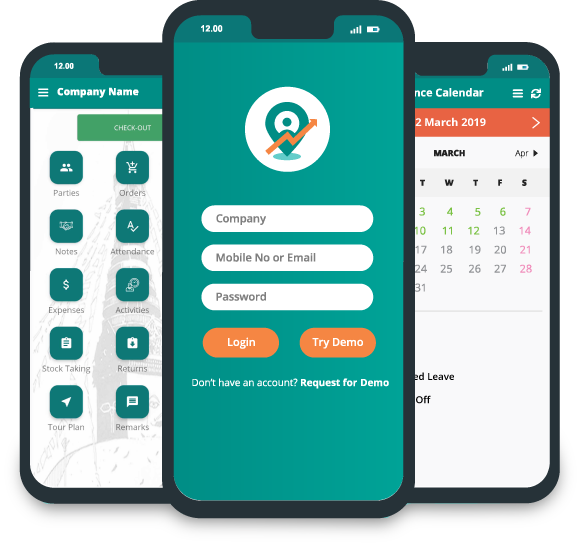
Delta Sales App is a field sales force automation and employee tracking platform designed for FMCG companies, manufacturers, wholesalers, and distributors managing outside sales teams.
It brings field employee management and everyday sales operations together, helping representatives manage customer visits, book orders, record collections, and submit daily work updates through a mobile application. Its main capabilities include:
-
Order Management: Representatives can book customer orders through the mobile application using product catalogues and customer information.
-
GPS Employee Tracking: Managers can monitor field representatives' locations, travel activity, and customer visits.
-
Beat Planning: Assign routes and customer visits to representatives to improve daily territory coverage.
-
Payment Collection: Record customer payments and monitor outstanding dues.
-
Attendance and Leave Management: Manage employee attendance and leave applications through the application.
-
Distributor and Party Management: Organize distributor, retailer, and customer information to support sales operations.
-
Stock Taking: Record retailer-level stock information to improve visibility into product availability.
-
Field Expense Reporting: Allow representatives to submit expenses for managerial review.
-
Automated Reports and Analytics: Access party-wise, representative-wise, attendance, order, and collection reports.
-
Offline Functionality: Representatives can continue supported field activities without an active internet connection, with data synchronizing when connectivity returns.
Why consider Delta Sales App as an Outfield alternative?
Delta is worth evaluating when a business needs more than outside sales CRM and visit tracking. Its combination of employee tracking, order management, payment collection, beat planning, and distribution-related features makes it relevant for companies managing recurring retail sales operations.
It is particularly suitable for businesses that want to connect field activities with everyday order and collection processes rather than managing these tasks through separate applications.
Consideration: Businesses should review the available modules, integration requirements, customization options, and implementation scope to ensure the platform matches their existing distribution workflows.
2. Skynamo
Skynamo helps outside sales teams manage customer visits, access product information, and capture orders through a mobile application. It also connects field activities with back-office systems. Its focus on mobile order taking and ERP connectivity makes it relevant for manufacturers and wholesalers that want to reduce manual order processing.
Consideration: Evaluate its distribution workflows and reporting capabilities against your requirements for secondary sales, retailer management, and payment collections.
3. Repsly
Repsly combines field team management with retail execution capabilities. It helps brands organize store visits, monitor in-store activities, and evaluate product availability and merchandising performance. Its reporting tools provide visibility into field activities and retail execution across store networks.
Consideration: Businesses requiring extensive distributor management, secondary sales, and payment collection should verify whether the available workflows cover their needs.
4. Bizom
Bizom is a retail intelligence and sales distribution platform designed for businesses managing complex route-to-market operations. It connects field sales activities with distributor operations and retail performance. Its capabilities are relevant to companies that need visibility across sales representatives, distributors, and retail outlets.
Consideration: Evaluate implementation requirements, available modules, and total costs based on the size and complexity of your distribution network.
5. FieldAssist
FieldAssist provides sales force automation capabilities for businesses managing distributed sales teams and retail operations. It supports field execution across different trade channels, including general trade, modern trade, and van sales. Its features help companies organize outlet visits, capture orders, and monitor representative performance.
Consideration: Businesses should assess its available modules, deployment requirements, and commercial structure before selecting it.
6. BeatRoute
BeatRoute combines sales force automation and distributor management systems for businesses operating through retail and distribution networks. Its platform supports field team management, retailer interactions, and sales execution. It also offers AI-assisted capabilities for activities such as sales recommendations and visit planning.
Consideration: Smaller businesses should evaluate whether its enterprise-oriented capabilities and configuration requirements match their operational needs.
7. Zoho CRM
Zoho CRM helps businesses organize customer records, manage sales pipelines, and monitor sales activities. Its broader Zoho ecosystem also provides additional applications for business operations and inventory-related workflows.
It is a practical choice for companies prioritizing customer relationships and sales pipeline management. Consideration: Businesses requiring dedicated beat planning, GPS employee tracking, and FMCG distribution workflows may need additional configuration or complementary applications.
8. Salesforce Sales Cloud
Salesforce Sales Cloud is a comprehensive CRM platform for managing customer relationships, sales opportunities, and revenue forecasts. Its customization and integration capabilities make it suitable for organizations with complex sales processes. Businesses in consumer goods can also evaluate Salesforce Consumer Goods Cloud for specialized retail execution requirements.
Consideration: Licensing, customization, implementation, and ongoing administration should be considered carefully. A specialized SFA application may be more practical for companies primarily looking to automate routine field sales activities.
Choosing the Right Outfield Alternative
Choosing a field sales platform should start with your existing sales process, not the number of features advertised by software vendors. A platform that works for a company managing customer relationships may not be suitable for an FMCG distributor handling hundreds of retailer orders every day.

Before making a decision, evaluate the following factors.
1. Understand Your Sales and Distribution Model
Identify how your business manages primary sales, secondary sales, and direct customer orders. For example, a manufacturer selling through distributors may need distributor-wise reporting, stock visibility, and retailer order tracking. A business managing direct sales representatives may prioritize customer records, product catalogues, and order processing. Choose software that supports your distribution structure without requiring major changes to your existing sales process.
2. Evaluate Order Booking Requirements
Order capture is one of the most important activities for representatives working in distribution-led businesses. Check whether the application supports:
-
Product catalogues and SKU-level ordering.
-
Customer-specific pricing and discounts.
-
Promotional schemes.
-
Previous order history.
-
Stock visibility.
-
Order status tracking.
-
Returns and payment collection.
Also, test the complete order journey. Representatives should be able to select a customer, add products, enter quantities, and submit orders without unnecessary steps.
3. Check Field Tracking and Beat Planning
If people who work in areas go to many different places on a regular basis, then using GPS tracking and planning the areas they cover should be something you look at. Check for things like GPS-based records of when employees arrive, proof that they met customers, checking that visits happened, planning the ways to get around, and reports that show what was planned versus what actually happened. For companies that need to visit the places over and over, the system should help with assigning areas to cover, setting up customer meetings, and seeing where there might be missing visits.
4. Test Offline Functionality
Do not rely only on a vendor's claim that its application works offline. Test the actual activities representatives perform when connectivity is unavailable. Can they access customer information? Can they book orders? Are visit records saved? What happens when the device reconnects? Understanding these workflows before implementation can prevent operational problems later.
5. Review Reporting and Analytics
Identify the reports your sales managers use regularly. These may include daily order summaries, DSRs, outlet coverage, representative performance, payment collections, attendance, and distributor-wise sales. Check whether these reports are available directly or require additional configuration. The objective is to reduce manual reporting while giving managers enough information to identify underperforming territories and take corrective action.
6. Assess Integration and Implementation Requirements
Your field sales application should fit into your existing business processes. Review integration requirements with ERP, accounting, inventory, and other business applications.
Ask vendors about:
-
Available integrations and APIs.
-
Data migration requirements.
-
Synchronization frequency.
-
Implementation timelines.
-
User training and onboarding.
-
Technical support and customization costs.
A smooth implementation is important because even a feature-rich application will deliver limited value if representatives and managers struggle to adopt it.
7. Compare Total Cost of Ownership
Do not compare software based only on the monthly subscription price. Consider the overall cost of using and maintaining the platform, including:
-
Per-user subscription charges.
-
Additional module costs.
-
Implementation and onboarding fees.
-
Integration and customization expenses.
-
Training and support.
-
Future costs as the sales team expands.
A platform that appears inexpensive initially may become costly if essential workflows require additional modules or extensive customization. The best choice is one that delivers the capabilities your business needs without introducing unnecessary complexity.
Final Thoughts
Outfield provides useful capabilities for managing outside sales teams, customer accounts, field activities, route planning, and order management. However, businesses with different distribution structures and reporting requirements may benefit from evaluating other platforms.
The right alternative depends on what your field representatives actually do throughout the day. For FMCG companies, manufacturers, wholesalers, and distributors that need employee tracking alongside everyday field sales operations, Delta Sales App is another option worth considering. Its combination of GPS tracking, beat planning, order management, payment collection, attendance, distributor management, and offline functionality helps businesses organize field activities through one platform. Rather than choosing software based on the number of features listed on a product page, evaluate how well it supports your actual sales process.
Get a personalized product demo of Delta Sales App to understand how its field sales and distribution management capabilities can fit your business requirements.