Selfie Attendance for Field Sales Reps: Gimmick or Game-Changer?

For businesses that manage field sales teams, checking attendance has always been a challenge. Sales reps work in areas, meet with distributors and retail stores, and don’t follow a typical office schedule. Because of this, managers often rely on reports or self-reported updates to know if their staff is present each day. It's not easy to track who is actually on the job, especially when they are out in the field all day.
Selfie attendance claims to simplify the process of tracking employee presence. It also brings up concerns about employee privacy. People worry about how their images are stored and used. There is also the risk of attendance manipulation. For example, someone might use a photo from the past. Ask a colleague to take a picture. Then there is the question: can a simple photo really improve accountability? Some companies see it as another way to watch employees. They feel it adds no value. Others believe it brings honesty to field operations. It helps ensure that workers are actually at their assigned locations. So, is selfie attendance for field sales just another digital attendance gimmick, or does it offer something traditional methods cannot?
This blog explains how it works, where it falls short, and what makes the difference between simply capturing a selfie and actually improving field sales management. If you need the basics first, read how selfie attendance helps track field employees.
The Case for Calling It a Gimmick
Selfie attendance seems easy to use. A new tracking method of who is present does not solve old problems on its own. Some companies try it hoping to get information about what is happening in the field. After that, they discover workers still find ways to skip the rules, and managers still struggle to verify that things are correct. It is just as hard to know how productive people are as it was before. For these reasons, companies wonder whether it is worth the effort.
-
Rep Pushback and Privacy Concerns
Reps might think selfie attendance is a waste of time, especially if the company doesn't explain why it's being brought in. Some people might feel uneasy about sending pictures of themselves on a regular basis, or they might ask how those pictures are kept and used. These concerns become more obvious when an attendance rule comes out without any explanation. Companies need to tell employees what information is gathered, who has access to it, and how long it is kept. What it will be used for. A clear policy helps workers see that the goal is to have work records and the goal is not to add more stress to their daily lives.
-
Reps can still game the system
A selfie-based attendance system is not automatically foolproof. If the application only takes a picture without checks, the selfie-based attendance system can still produce wrong attendance records. For instance, a worker might try to use a picture or send attendance from a place that is not the assigned area. Set GPS permissions, weak verification checks, and little manager supervision can also lower the reliability of the selfie-based attendance system. That is why companies should look at the attendance process instead of judging the software only on its selfie capture feature.
What Attendance Records Cannot Tell Managers?
An attendance record confirms when a representative starts or ends the working day, but it does not explain how effectively that time is spent. In field sales, a rep may check in on time and still miss important retail outlets, deviate from the assigned beat, or leave customer visits incomplete.
This creates a gap between recording employee presence and evaluating actual field performance. Managers need to understand what attendance data can establish and where additional operational information is necessary.
-
Attendance Does Not Equal Productivity
A representative can have a perfectly recorded attendance entry without completing the day's assigned work. For example, checking in at 9 AM does not confirm whether the rep followed the planned route, visited priority retailers, or completed the expected number of customer visits. This is why businesses should avoid treating attendance records as a standalone measure of employee performance. Attendance establishes working-time accountability, while visit records, beat-plan execution, and sales reports help managers evaluate field activity.
-
No Visibility Once Reps Leave the Office
Many companies track office attendance well but still have trouble watching their field reps once those reps leave the office. A sales rep might check in at a distributor’s location. Then go to another area without updating the manager. Another rep might skip stores, miss key retailers, or waste time driving between places. Without real-time visibility into the field, managers can’t tell if delays are due to issues or if reps are not following the plan. This leads to poor territory coverage, weak retail execution, and lower distributor performance.
-
Payroll and Incentive Disputes Built on Self-Reported Data
Attendance records often feed into salary calculations, leave adjustments, travel reimbursements, and incentive eligibility. When those records rest on manual entries or unverified submissions, disputes are hard to settle. A rep may say they worked a full day while the manager has nothing to show the actual check-in time or what they did in the field. Travel claims are just as hard to validate when no reliable record of the rep's movement exists. Accurate attendance and field activity records give HR and sales managers a steadier basis for reviewing these claims.
Why Selfie Attendance With GPS Tracking Is a Game-Changer
Selfie attendance gets a lot more useful once GPS tracking is part of it. The two answer different questions. A selfie helps establish who is checking in, and GPS shows where the check-in happens. Add field activity data, and managers can see how reps start their day and what they do with it.
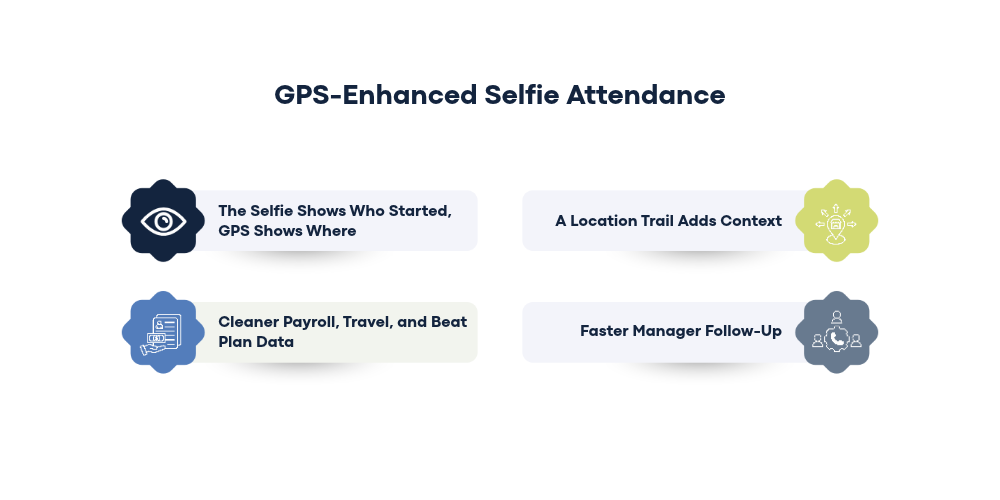
The Selfie Shows Who Started, GPS Shows Where
A photo adds an identity verification record, and GPS adds location context to the attendance entry. Say a rep assigned to a sales territory checks in at the start of the day. The system captures the photo, records the time, and ties the entry to the available GPS coordinates. A manager can then check whether the check-in happened at an expected or authorized location. That tells you a lot more than an entry showing only an employee's name and reporting time.
A Location Trail From Check-In Through the Day's Visits
The next step is connecting attendance with field activity. A morning check-in tells managers where a representative started. It does not explain what happened during the remaining working hours. GPS-based employee tracking and customer visit verification can provide additional operational visibility. For example, a manager can review:
-
The representative's recorded starting location.
-
Assigned beat plan and planned retail outlets.
-
Actual customer visit records.
-
Location information associated with verified visits.
-
Available movement and activity records during working hours.
This helps managers identify gaps between planned and actual territory coverage.
Cleaner Data for Payroll, Travel Claims, and Beat Plans
When attendance, location, and field activity records live in places, managers spend a lot of time comparing them. I notice that putting them together makes operational reviews more consistent. HR can refer to verified attendance information when reviewing working days and attendance exceptions. Sales managers can compare field activity with the assigned beat plans. Finance can use the travel and expense records as supporting evidence when reviewing reimbursement claims.
Faster Manager Follow-Up on Late or Missing Reps
Without an attendance reporting system, managers must contact each representative individually to confirm that attendance has begun. I have seen how this task becomes difficult when a manager handles thirty, fifty, or one hundred field employees spread across territories. A central dashboard can flag representatives who have not checked in,, who checked in late, or who have left an attendance record. Managers can follow up early, and attendance gaps no longer appear at the end of the day.
Selfie Attendance Compared With Other Methods
Selfie attendance is not necessarily the best option for every business. Its usefulness depends on the type of workforce, operational requirements, and verification needs. Understanding how it compares with other methods helps companies select an appropriate system.
-
Selfie With GPS vs GPS-Only Check-In
GPS attendance tracks where an employee is when they check in. That is useful for people working outside the office. It does not include a picture of the person who checked in. Selfie attendance, with GPS, adds another way to make sure the right person is checking in by linking a picture to the place and the time. For companies that have sales teams spread out, this provides information when looking at the attendance records.
-
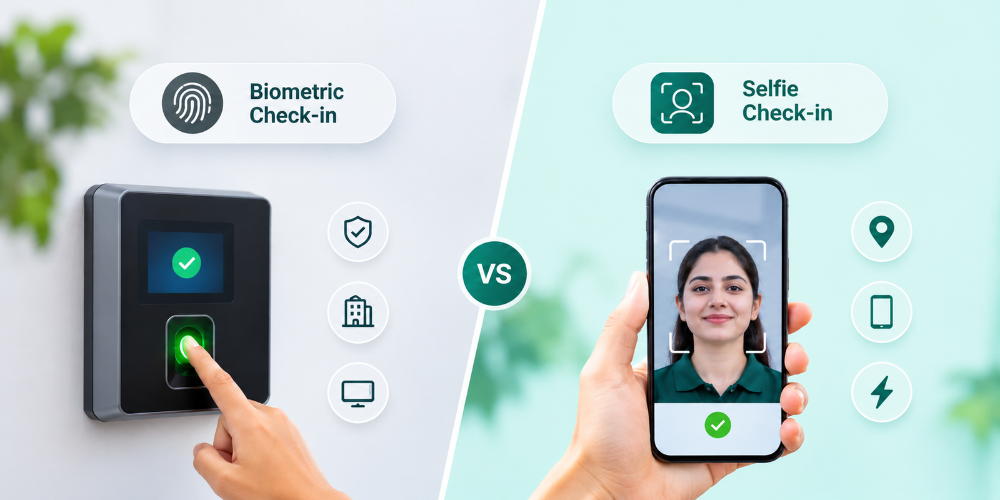
Selfie With GPS vs Biometric Devices
Biometric devices use biological traits to check if an employee is who they say they are. These tools are helpful in offices, warehouses, factories, and other places where people work in one spot. Sometimes field representatives can't go to a special biometric machine before they start their day. Selfie attendance combined with GPS gives freedom because workers can log in using their phones.
-
Selfie With GPS vs. Customer Visit Check-Ins
These two features serve different operational purposes. Selfie attendance records the beginning or end of an employee's working day. Customer visit check-ins record field activity at specific retail outlets, distributors, or customer locations. For example, a representative may successfully mark attendance at 9 AM but visit only 10 out of 20 assigned outlets. Customer visit tracking helps managers understand this execution gap. For a field sales organization, the two systems complement each other. Attendance establishes the working-day record, while customer visit verification provides visibility into actual sales activity.
What to Look for in a Selfie Attendance Feature
Not every mobile attendance application offers the same level of verification. Before selecting a solution, businesses should evaluate how the attendance feature works within their existing field sales operations.
-
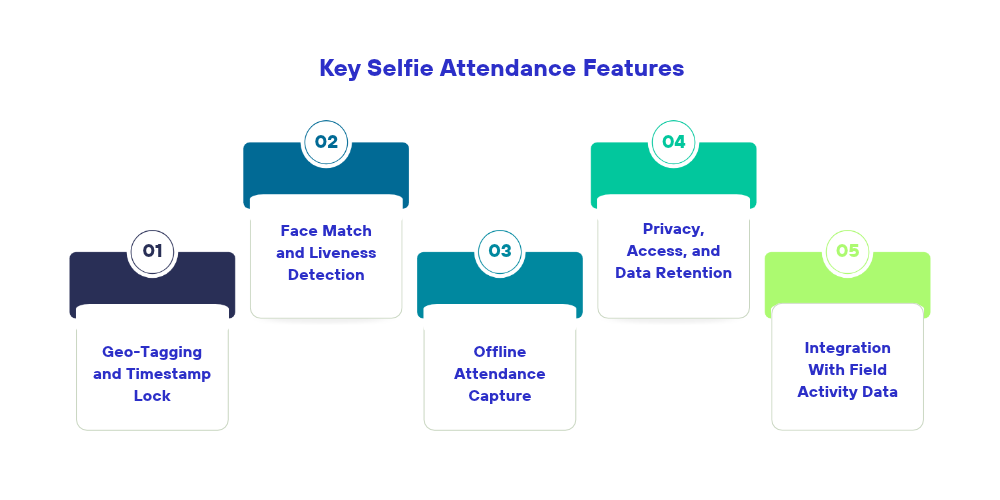
Geo-Tagging and Timestamp Lock
Every attendance entry must contain a timestamp and, if supported, GPS coordinates. Geo‑tracking helps managers understand where a representative submitted attendance, while a timestamp record establishes when the entry was made. Businesses should also check whether the system supports authorized attendance locations, exception reporting, and controls against modifying submitted attendance records. These attendance capabilities are particularly important for organizations managing representatives across distributor territories.
-
Face Match and Liveness Detection
A selfie capture feature and facial verification are not the same thing. Basic selfie attendance captures a photograph and stores it with the attendance record. Face matching compares the captured image with an enrolled employee photograph, helping verify identity. Liveness detection goes further by checking whether the submitted image comes from a live person rather than a static photograph or screen. Companies handling sensitive employee information should also evaluate data protection practices, access permissions, retention policies, and applicable privacy requirements.
-
Offline Capture for Low-Network Territories
Network availability is a common challenge for field sales teams. Representatives covering rural markets, remote retail outlets, or areas with inconsistent mobile connectivity may not always have a stable internet connection. An attendance application should explain how it handles network interruptions. Where offline capture is supported, the application can store attendance information locally and synchronize it when connectivity returns. Businesses should verify how timestamps, location records, and synchronization failures are handled.
-
Selfie Attendance and GPS Tracking in One Platform
Using separate applications for attendance, employee tracking, and sales reporting can create unnecessary administrative work. Managers may have to compare attendance registers with GPS reports, customer visit records, and Daily Sales Reports (DSRs) to understand what happened during a representative's working day.
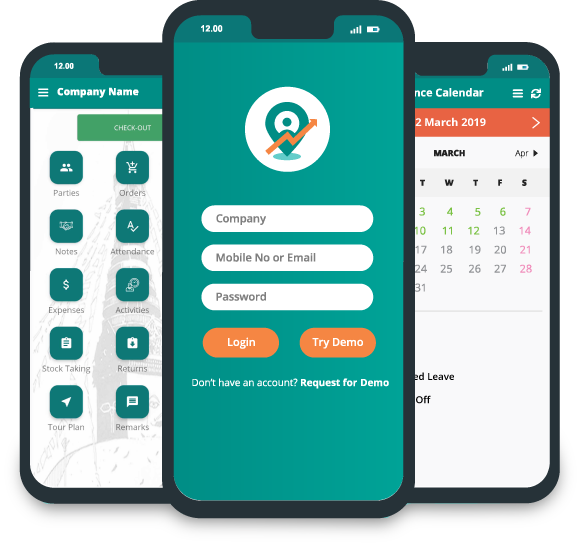
Delta Sales App provides field sales automation and employee tracking capabilities that help businesses manage attendance, field activity, and sales operations through a centralized platform. Its capabilities include GPS-based employee location tracking, attendance management, customer visit tracking, beat planning, order management, payment collection, and real-time sales reporting.
How to Measure Whether It Is Working
Implementing selfie attendance is only the first step. Businesses need to measure whether the system is actually improving attendance accuracy and reducing administrative problems. A useful evaluation should consider both attendance-related outcomes and their impact on field operations.
On-Time Start Rate and Missed Check-Ins
The on-time start rate measures the percentage of representatives who check in within the company's defined reporting window. For example, if 40 representatives are expected to start by 9 AM and 34 check in on time, the on-time start rate is 85%. Companies can monitor this metric over time to identify recurring delays across employees, territories, or distributor locations. Missed check-ins should also be tracked separately. A missed check-in does not always indicate absenteeism. It could result from network problems, device issues, or an employee forgetting to record attendance. Managers should investigate exceptions before making attendance decisions.
Drop in Fake Attendance and Claim Disputes
Another important measure is the reduction in attendance irregularities and disputes. Businesses can compare the number of disputed attendance entries before and after implementing the system. They can also monitor:
-
Attendance entries flagged for verification.
-
Repeated late check-ins.
-
Missing or incomplete location records.
-
Discrepancies between attendance and field activity.
-
Payroll and travel reimbursement disputes.
For example, if HR previously spent several hours every month resolving attendance-related discrepancies, a more reliable attendance system may reduce that administrative burden.

How to roll it out without losing your team’s trust
Reps judge a new attendance feature fast. If it arrives as a notice saying everyone must now check in with a selfie, most will assume it exists to catch them out.
-
Write a clear policy on what is captured and stored
Put the rules in writing before launch. Say what the app collects at check-in (a photo, the time and the location), who can see it and how long it is kept. State the working hours that tracking covers and make clear nothing is recorded outside them.
-
Pilot with one region first
Start with one team of fifteen to twenty reps for four to six weeks. You will find the weak network areas and the policy questions you missed before the whole field force sees them. Reps in other regions will also hear about it from colleagues, which lands better than a notice from head office.
-
Give reps something back, such as faster reimbursements
When attendance, location and visits sit in one record, travel claims can be checked quickly and paid sooner. Verified attendance also protects a rep if an absence or incentive is disputed later. Tell reps about these benefits at launch and make sure they show up in the first payout.
Conclusion:
Selfie attendance for field sales is more than a gimmick when it addresses the actual challenges of managing a distributed workforce. However, capturing a photograph alone is not enough. Businesses need reliable location verification, accurate attendance records, and visibility into what representatives do after checking in.
For FMCG companies, distributors, and manufacturers, combining selfie attendance with GPS tracking and field sales automation can improve attendance accountability, simplify management, and provide better visibility into daily sales operations.
With Delta Sales App, businesses can bring employee tracking, attendance management, customer visit verification, beat planning, and sales reporting together in one platform.
Want better visibility into your field sales team? Get a personalized product demo of Delta Sales App and see how it can help streamline attendance management and field operations.